
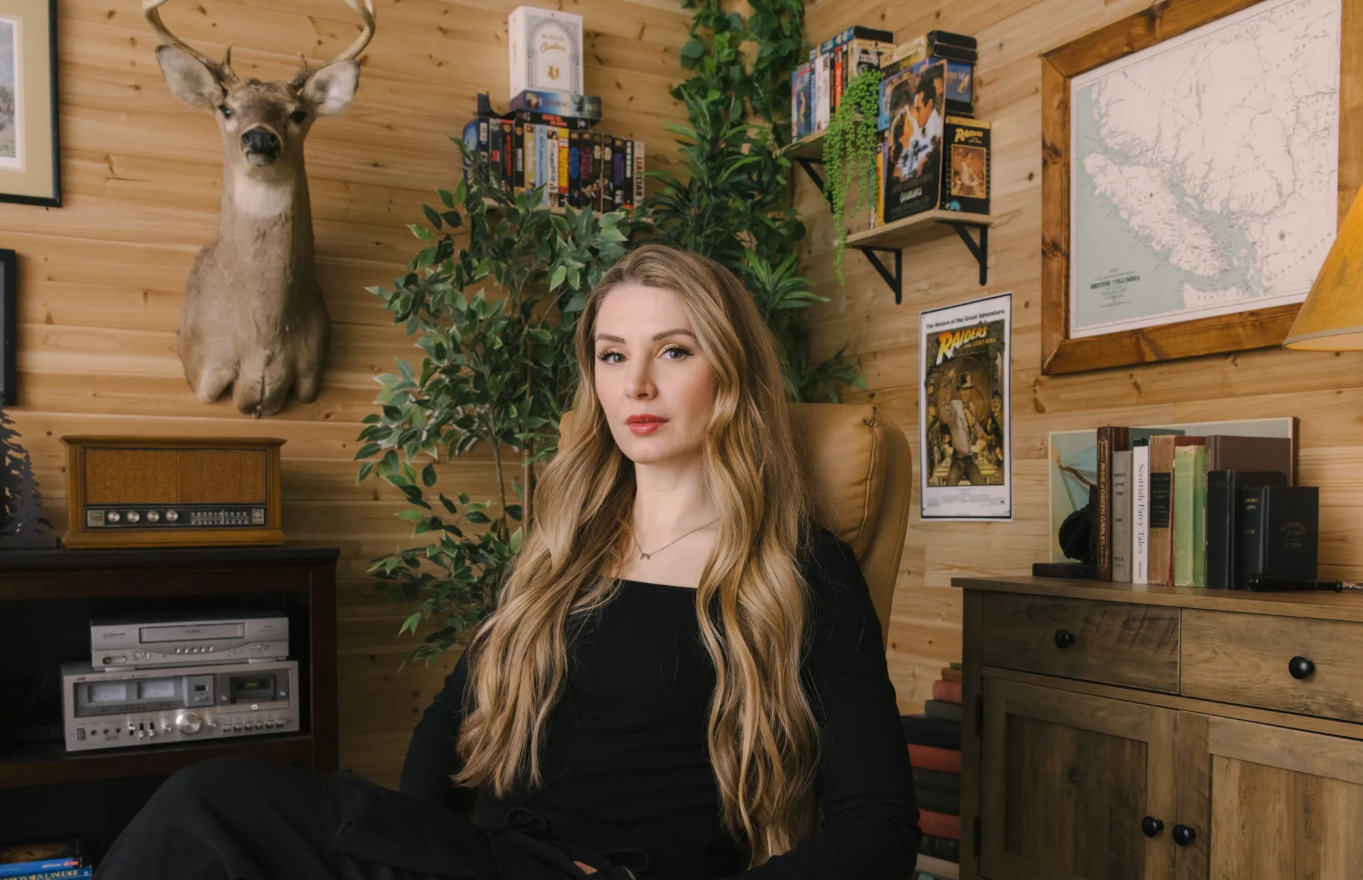
Lauren Southern became internationally known during a period when social media was fundamentally changing political communication. Born in Surrey, British Columbia, in 1995, she emerged in the mid-2010s as a young Canadian political activist and online commentator and became associated with the alt-right. Her videos and political activism focused heavily on immigration, identity, feminism and free speech, frequently generating intense controversy. Her career offers a revealing example of how digital platforms created a new category of political personality capable of reaching large international audiences without relying on traditional television networks or newspapers.
Entering Politics at a Young Age
Southern studied political science at the University of the Fraser Valley but left before completing her degree. Politics had already become more than an academic interest. She began producing commentary and became involved with Rebel Media, a Canadian right-wing media organization, where her profile expanded significantly.
The timing was important. Facebook, Twitter and particularly YouTube were becoming increasingly influential spaces for political discussion. Younger commentators no longer needed to spend years moving through traditional journalism before reaching a significant audience. A provocative video could reach hundreds of thousands or even millions of people, while controversy itself could increase visibility.
Southern proved particularly effective at operating within that environment. Her videos addressed subjects that were already producing intense ideological conflict, and supporters and critics alike circulated her material. This dynamic helped transform her from a Canadian online commentator into an internationally discussed political figure.
Controversy as a Defining Part of Her Public Profile
Southern’s political activities quickly generated criticism. Her commentary on immigration, multiculturalism and identity, along with her association with far-right political activism, made her a deeply polarizing figure. Critics argued that some of the ideas and narratives promoted through her work contributed to hostility toward immigrants and minority communities, while supporters frequently presented her as someone willing to challenge political orthodoxies.
In 2017, Southern participated in activities connected with Defend Europe, a campaign involving far-right activists who sought to interfere with NGO search-and-rescue operations involving migrants in the Mediterranean. The episode became one of the most controversial periods of her early career and significantly increased international attention surrounding her activism.
The distinction between political commentator and political activist was therefore frequently blurred. Southern did not merely discuss controversial movements from a distance; at various stages she became directly involved in political actions and campaigns. That involvement intensified both the loyalty of her audience and the criticism directed toward her.
Documentary Projects and Independent Media
After leaving Rebel Media in 2017, Southern continued working independently. She produced online videos and documentary-style projects addressing issues such as migration and South Africa. These productions allowed her to create longer narratives than conventional social-media commentary and distribute them directly to an established online audience.
This independent model illustrates an important transformation in political media. Historically, producing and internationally distributing a documentary required significant institutional support. Digital platforms dramatically lowered those barriers. A creator with a sufficiently large following could finance, produce and distribute material while bypassing many traditional media organizations.
That independence also raises questions about editorial oversight and verification. Traditional journalism typically involves editors and institutional standards, whereas independent political creators can exercise far greater control over framing and selection. Southern’s work has consequently been interpreted very differently by supporters and critics.
Leaving Public Life and Returning
In 2019, Southern announced that she was stepping away from political activism and public life. The decision was striking because her online identity had become closely connected to political confrontation. She subsequently spent a period largely outside the highly visible role she had previously occupied.
Southern later returned to online commentary, but her public story had become more complicated. She discussed changes in her personal life and reflected on parts of the political environment in which she had previously operated. That evolution attracted attention because audiences often expect political personalities to maintain fixed identities, while real individuals may change their views, priorities or relationships over time.
Her later work has therefore been interpreted partly through the lens of her earlier activism. Even when the subject changes, an established public reputation continues to shape how new statements are received.
A Product of the Social-Media Political Era
Southern’s rise illustrates how radically political influence changed during the 2010s. She did not need elected office, a major newspaper column or a national television program to become internationally recognizable. Social platforms gave her direct access to an audience and rewarded content capable of generating strong reactions.
This environment also contributed to polarization. Algorithms and sharing mechanisms often amplify material that produces emotional responses, while political creators can build communities around highly contested issues. Southern’s career developed within precisely this ecosystem.
Understanding her influence therefore requires looking beyond the individual commentator. Her trajectory is also a case study in the transformation of political media itself: the collapse of traditional barriers to publication, the growth of personality-driven commentary and the increasing difficulty of separating journalism, activism and entertainment online.
A Polarizing Legacy
Lauren Southern remains a controversial figure whose work has produced sharply opposing interpretations. Any serious account of her career must acknowledge both the audience she developed and the substantial criticism directed at her political activities and rhetoric. Describing that controversy accurately is particularly important because many of the subjects she addresses—immigration, ethnicity, nationalism and identity—have significant real-world consequences.
Her trajectory nevertheless provides an important window into a particular era of Internet politics. She became famous at a time when YouTube personalities could rapidly acquire political influence that previously belonged primarily to established media institutions. The result was a career shaped by controversy, activism, online distribution and repeated reinvention.
Whether viewed primarily as an activist, commentator or digital-media personality, Southern’s public story demonstrates the extraordinary power—and equally significant risks—of building political influence in an environment where attention can travel around the world almost instantly.